


After the Surgical Bra: When Can You Wear a Regular Bra, and What Comes Next?
Moving on from the surgical bra rarely means going straight back to your old favorites. When you can wear a regular bra again is your surgeon's call, and it depends on your surgery, how your incisions are healing and how your swelling settles. The next step is often a soft, supportive, wire-free bra, and for many, that becomes the bra they choose every day.
You may have already opened your bra drawer and wondered whether your old favorites are ready for you yet, whether they will still fit, and what to wear in the meantime.
**Every timeline in this article comes from a hospital or surgical society, linked where it appears. It's general information, not medical advice: your surgeon and care team decide what's right for you.
When can you wear a regular bra after breast surgery?
When your surgeon or care team says so, usually at a follow-up appointment. Published timelines vary by surgery and by surgeon: in a 2025 guide from the American Society of Plastic Surgeons, one plastic surgeon says most patients can return to their normal bras in about one month, while still avoiding bras without proper support for three to six months.
Patient instructions agree: your doctor will tell you when you can stop wearing the surgical bra (MyHealth Alberta) and when you can wear a regular bra (Nova Scotia Health).
For many women, the transition from a surgical bra begins with something that is:
- Soft
- Supportive
- Wire-free
Moving beyond a surgical bra doesn't mean leaving comfort and support behind. As your recovery progresses, your needs may change, and the right bra can continue to provide support throughout each stage.
Your surgeon or care team will help determine when it's appropriate to transition and what level of compression is right for you.
How long do you wear the surgical bra before switching?
As long as your surgeon asks you to, which varies from person to person. As one example, an NHS hospital's current instructions call for day-and-night support for at least 2 weeks after a lumpectomy and at least 6 weeks after a mastectomy with reconstruction (Royal United Hospitals Bath).
We walk through the published guidance procedure by procedure in how long to wear a compression bra after surgery.
How do you know you're ready to switch?
Your care team makes this call. The most useful things you can bring them are good questions and honest notes about how you feel. Here's what's worth raising at your follow-up.
1. Ask directly.
Two questions, because they often have two different answers:
"Can I wear a soft, wire-free bra now?"
"Is there anything I should keep waiting on, and for how long?"
2. Tell them about your incisions.
Mention any spot that's still open, scabbed or taped, and where it sits, since that affects where a band or cup will land. One plastic surgeon quoted by ASPS notes there is often an incision in the fold under the breast, and says bras with bands that sit a little lower than the natural breast fold feel best.
3. Tell them how your swelling changes through the day.
If you feel comfortable in the morning and more swollen by evening, mention it. It's useful information for your team.
4. Check how the bra goes on.
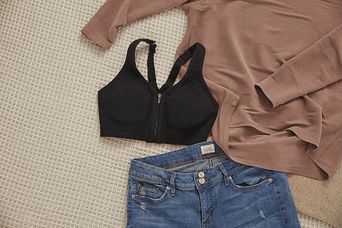
Back hooks mean reaching behind you, and if that still pulls, a front closure may feel easier for now.
Once you're cleared, try a new bra at home for a few hours first. If you notice pressure on a scar, red marks that don't fade or more swelling by evening, take it off and check in with your care team before trying again.
What should you wear after your surgical bra?
Whatever your care team recommends for your stage of recovery. For many, that's a soft, supportive, wire-free bra with nothing pressing on the fold. In the American Society of Plastic Surgeons' 2025 guide, one plastic surgeon recommends soft, breathable fabric, a wide band and straps and a racerback, and the guide notes that many patients prefer front closures (ASPS).
Recovery often moves through a few steps. Your care team decides which one you're on, how long you stay there and how much compression you need along the way.
Step 1: The surgical bra. Usually front-closing and wire-free, worn the way your surgeon prescribes.
Step 2: The step-down. Still front-closing, still wire-free, with the level of compression your care team recommends.
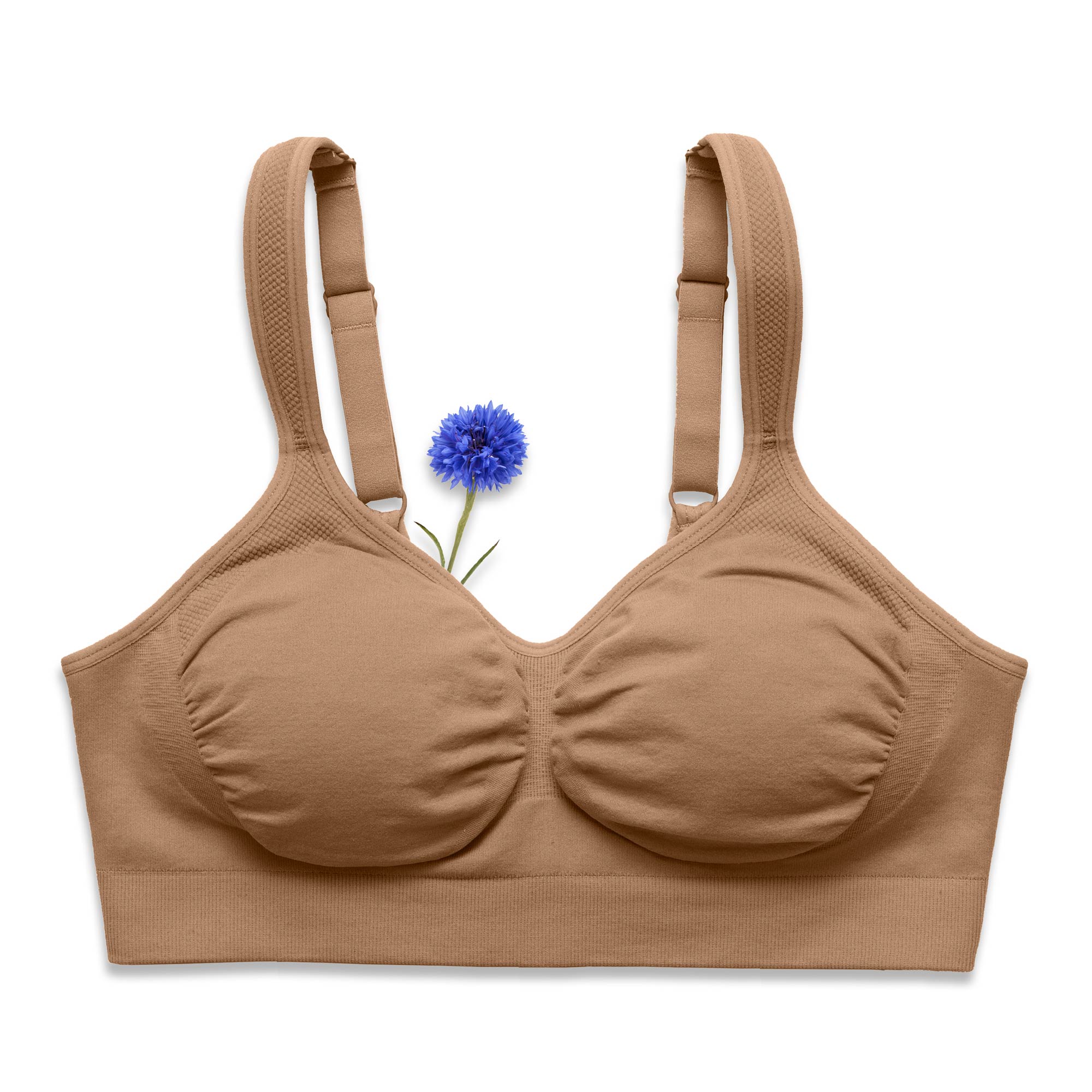
Step 3: Everyday wire-free. Soft, wire-free support to wear every day, with a closure that suits you. For many, this is the bra they keep.
Step 4: Your regular bras, if you want them. Once your surgeon says yes, some return to their previous bras.
Not everyone takes every step. Many stay at step three because they prefer how it feels, and some keep a compression bra in their week for the long term on their care team's or therapist's advice.
When can you wear an underwire bra again?
That's a question for your surgeon, because the answer depends on your surgery and where your incisions are. Published advice varies: Memorial Sloan Kettering's instructions after breast implant surgery say no underwire for 6 weeks and then to ask your doctor, and UW Medicine's augmentation instructions say no underwire bra until your incisions are fully healed.
So ask one specific question at your follow-up: "Where are my incisions, and where would a wire sit?"
After weeks in something soft and wire-free, many find they don't miss underwire at all.
When can you wear a regular bra after breast reduction?
When your surgeon clears you, and for many the first step is a soft, wire-free bra. A plastic surgeon writing on the ASPS blog says that about one month after surgery you can be fairly confident in your new size and measure for new bras, and to talk to your surgeon before going back to underwire.
A reduction brings two considerations of its own. Your size is new, so bras made for your previous shape may not fit the way they used to. And there is usually an incision in the fold of the breast, as one ASPS-quoted surgeon puts it, right where a band sits.
Swelling can also take longer to settle than expected: the ASPS blog post adds that most patients say it takes 3 to 4 months for all of the swelling to go away.
Still in the early weeks? Here's what to wear after a breast reduction while you heal.
When can you wear a regular bra after breast augmentation?
Your surgeon will tell you at a follow-up. Memorial Sloan Kettering's instructions after breast implant surgery say to wear a soft, supportive bra for 6 weeks, even while sleeping.
That care matters because one of the standard augmentation incisions sits in the fold under the breast (ASPS), right where a bra's band sits.
When can you wear a regular bra after a breast lift?
After a breast lift, your surgeon will tell you what to wear and when that changes. In the early weeks, ASPS describes an elastic bandage or support bra that minimizes swelling and supports your breasts as they heal (ASPS).
The American Society of Plastic Surgeons also notes that a lift incision can run horizontally along the breast crease, so ask your surgeon what you can comfortably wear over it.
What do you wear a few weeks after a lumpectomy?
That depends on how your incision is healing, whether you have drains and whether radiation comes next. As one example, the Royal United Hospitals Bath (NHS) advises a supportive, non-wired bra day and night for at least the first 2 weeks after this surgery, which hospitals call a wide local excision.
The first days have their own rules (front-opening everything, nothing over your head), and we cover them in what to wear after a lumpectomy.
A few weeks on, two things shape what comes next.
Radiation. If radiation is part of your plan, the McGill University Health Centre's breast radiotherapy guide recommends cotton bras without underwire (MUHC), and Mercy's radiation guide says that if your skin is irritated, wear a soft cotton bra, a camisole or no bra. Your radiation team will tell you what's right for your skin.
Lymph nodes. If lymph nodes were removed, ask your care team or lymphedema therapist whether to keep some compression in your week for the longer term. Our physical therapist's guide to compression bras for lymphedema explains how that works.
When can you wear a regular bra after a mastectomy?
After a mastectomy, the switch is led by your surgeon and care team, and with reconstruction it often takes longer. Memorial Sloan Kettering tells patients to keep wearing the surgical bra until the drains are removed and then ask their care team what to wear, and the Royal United Hospitals Bath advises a soft, non-wired bra day and night for at least 6 weeks after a mastectomy with reconstruction.
We cover this in more depth in what to wear after a mastectomy.
When can you wear a sports bra and exercise again?
Once your surgeon clears you for activity. A plastic surgeon on the ASPS blog says to wear a supportive bra when you work out for the first time after a reduction, and Memorial Sloan Kettering advises a soft, supportive bra when you exercise after implant surgery.
Two things make a workout bra after surgery different from the one you had before:
- wire-free support that holds everything still, with nothing pressing on the fold
- a closure you can manage, because pulling a tight sports bra over your head may be uncomfortable on a healing chest
Not sure whether the gym calls for a sports bra or a compression bra? We break down compression bra vs. sports bra here.
Can you go braless after breast surgery?
That's your surgeon's call. One plastic surgeon quoted by the American Society of Plastic Surgeons recommends avoiding bras without proper support for at least three to six months, typically.
If your surgeon says yes, you might start with short stretches at home and notice how you feel by evening. If you feel sore, heavy or swollen, mention it at your next appointment.
Which Hugger fits each step?
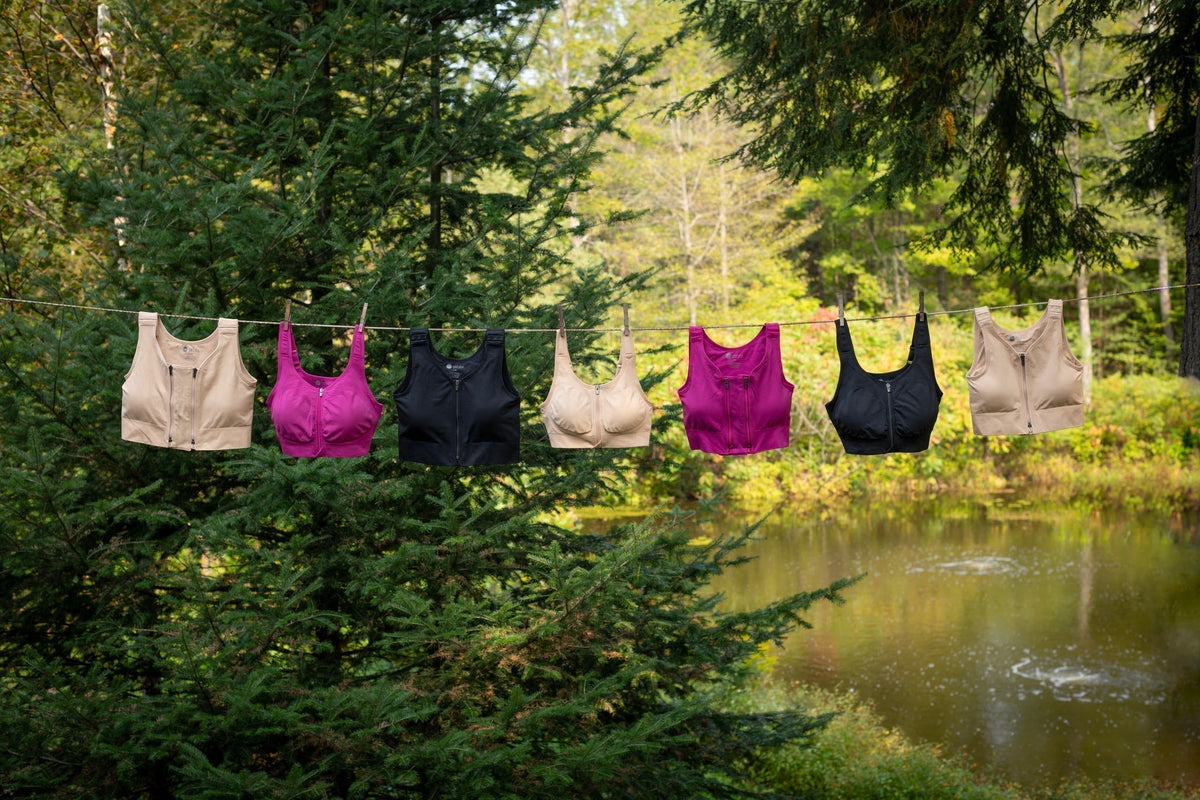
Every Hugger is designed around the same idea: support comfortable enough to live in, through recovery and every day after.
- Powered by SENSIVA™ Skin-First Compression Technology. 360° zoned, gradient compression for support all the way around you, not just across the front, plus antibacterial and moisture-wicking performance.
- Wire-free by design. There's no wire in any Hugger, at any step.
- Comfort, day and night. Made with OEKO-TEX® STANDARD 100 certified materials, tested for harmful substances. HuggerPRIMA and HuggerVIDA are designed for 24/7 wear.
- Made to adapt. Front zips on HuggerPRIMA, HuggerVIDA and HuggerLUMA. Just ONE Measurement to find your size. And if swelling or bandages need more room, the zip-in PrimaEXTENDER flexes HuggerPRIMA's fit.
Here's how the range lines up with the steps above. Everyone's recovery and compression needs are different, so treat this as a guide rather than a set order:
- HuggerPRIMA: high compression, front zip, full coverage, with pockets for pads or prosthetics. Often the first Hugger after surgery.
- HuggerVIDA: medium compression, front zip. Designed for moving on from higher compression after surgery, for lymphedema management and for everyday wear.
- HuggerARIA: light to medium compression with a back closure, designed for everyday wear once reaching behind you feels easy.
- HuggerLUMA: a high-impact compression sports bra with a front zip, for when you're cleared to move again.
HuggerVIDA and HuggerARIA live together in our Everyday collection, made for everyday comfort long after the surgical bra.
Not sure which Hugger fits where you are right now? The Fit Guide takes about a minute, or reach out and Team Prairie will help.
Common questions
1. How long do you wear a surgical bra before switching to a regular bra?
As long as your surgeon asks. One NHS hospital, for example, calls for day-and-night support for at least 2 weeks after a lumpectomy and at least 6 weeks after a mastectomy with reconstruction.
2. When can I wear a regular bra after breast reduction?
When your surgeon clears you, often starting with a soft, wire-free bra. One plastic surgeon on the ASPS blog says you can measure for new bras about one month after surgery.
3. When can I wear a regular bra after breast augmentation?
When your surgeon says so. Memorial Sloan Kettering's instructions after implant surgery say to wear a soft, supportive bra for 6 weeks, even while sleeping, and to ask your doctor before going back to underwire.
4. What should I wear a few weeks after a lumpectomy, once the drains are out?
Many wear a soft, supportive, wire-free bra, as their care team advises, and hospital radiotherapy guides recommend cotton bras without underwire for treated skin.
5. When should I get fitted for new bras after breast surgery?
Ask your surgeon. One plastic surgeon quoted by ASPS recommends waiting a full three months after most breast procedures; another says you can measure for new bras about a month after a reduction.
6. Can I go braless after breast surgery?
Only once your surgeon says so. One plastic surgeon quoted by ASPS recommends avoiding bras without proper support for at least three to six months, typically.
7. Is the HuggerVIDA a step down from the HuggerPRIMA?
In compression level, yes: HuggerPRIMA is high compression and often the first Hugger after surgery, while HuggerVIDA is medium compression and also designed for everyday wear. Both have a front zip, and your care team decides the level of compression you need.
Comfort that stays with you
Some return to their old bras once their surgeon says yes. Others find their shape has changed and start fresh once the swelling settles. And many find that a soft, wire-free Hugger has become the bra they reach for every day.
Every path is a normal one. Whichever way your recovery takes you, Team Prairie is always happy to help you find what feels right.
Disclaimer: This article is for educational and informational purposes only and is not intended to replace medical advice, diagnosis, or treatment. Always consult your healthcare professional with any questions about your individual recovery or compression needs. If your medical professional has any questions about Prairie Wear Huggers, we'd love to connect. We're all about creating communities of support here at Prairie Wear. 💛